May 28, 2025
AKIS in action: Fostering knowledge flows and innovation – Aligning research with practice needs, 2nd session
As part of ongoing efforts in modernAKIS to interconnect AKIS (Agricultural Knowledge and Innovation Systems) actors across Europe, this event focused on how research can achieve real-world impact through multi-actor and co-creation approaches that bridge science and practice.
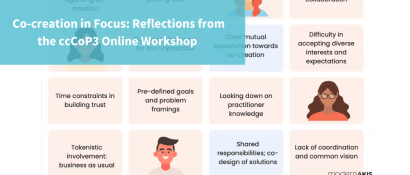
Sangeun Bae from the University of Hohenheim highlighted the main challenges researchers face when working with multi-actor approaches. This growing trend, driven by EU policies and research agendas, calls for researchers to take on new roles such as facilitators, knowledge brokers, communicators, and change agents. Her study for the modernAKIS project identified three levels of barriers for researchers:
🔸At the individual level, researchers often struggle with skill gaps, building relationship, conflicting expectations, and low engagement from external partners.
🔸At the institutional level, challenges include inadequate incentives, lack of clear standards for co-creation, rigid funding structures, complex legal rules, and limited political support.
🔸At the societal level, persistent issues like the dominance of scientific knowledge over practical knowledge and scepticism toward collaboration remain obstacles.
Overcoming these barriers requires coordinated support across all levels, investment in relationships, institutional reforms, and structural changes to move beyond “co-frustration” and unlock the full potential of co-creation.
After this, speakers shared examples of multi-actor and co-creation approaches. Jennie Cederholm Björklund from the Swedish CAP Network introduced the Swedish knowledge hubs—explaining their challenges and goals—, and presented four hubs focused on Livestock Production, Business Management & Entrepreneurship, Environment & Climate, and Digitalisation. These hubs work closely together. The AKIS CAP Network and Coordination Body supports them with an evaluation planned for the near future.
Niklas Bruhn from the University of Vienna presented Austria’s Lighthouse Farms network, which focuses on long-term innovative farming practices that improve soil health. The project studies 104 pioneer farms that use soil-enhancing methods and compares them to conventional farms to identify effective management practices. Key results show that crop diversity and cover cropping significantly increase soil organic carbon, especially in lighter soils. The project emphasizes co-creation by actively involving farmers and sharing results through an interactive website to support knowledge exchange. This approach aligns with EU soil health goals and highlights the vital role of farmer-driven innovation in sustainable agriculture.
During the Q&A, there was strong interest in how Knowledge Hubs connect science and practice. Despite differences in their structures, all hubs share the goal of improving advisory services and making research more relevant. A further goal is to bring all hubs and topics together in a common knowledge bank.
A key challenge discussed was communication across disciplines, where hybrid roles—such as advisors with research expertise—and trust building are essential. Sangeun Bae emphasized that the challenge goes beyond language to include differences in values, assumptions, and goals. Projects as Niklas’ also showed that working with real farms requires flexible scientific methods and that advisors play a central role in engaging farmers and facilitating knowledge flow. The speakers agreed that farmers hold vast knowledge, and that knowledge exchange must go both ways. Above all, it is crucial that all actors—researchers, advisors, and practitioners—engage with each other as equals.
Watch the videos from the WoW AKIS in action: Fostering knowledge flows and innovation: Aligning research with practice needs, 2nd session